What Makes a Great School Assembly?

What Makes a Great School Assembly?What Principals Should Look For Before Booking the Speaker
A great school assembly does more than fill an hour in the schedule. It creates energy, delivers a message that matters, and gives students something they carry with them after they leave the room. The best assemblies do not feel like interruptions to the school day. They feel like a reset, a reminder, and sometimes even a turning point.
If you are a principal or school leader, you already know that not every assembly is created equal. Some are loud but forgettable. Some are polished but disconnected. Some get applause in the moment, but do not change anything once the room clears. A great assembly, on the other hand, reaches the heart and the mind. It gives students something to think about, teachers something to reinforce, and leaders something to build on.
The first thing that makes a great assembly is relevance. Students need to feel like the message was designed for them, not recycled for any school that booked the date. Whether the topic is leadership, resilience, kindness, focus, or overcoming adversity, the message should connect to what students are actually experiencing. Relevance is what makes students lean in instead of checking out.
The second thing is connection. A speaker can have a strong message and still miss the room if they do not connect quickly. Students decide fast whether someone is worth listening to. The best speakers know how to establish trust early, speak with clarity, and communicate in a way that feels real. They do not hide behind big words or overproduce the moment. They make the room feel seen.
A great assembly also has structure. It should have a clear beginning, middle, and end. Students should be able to follow the arc of the message without feeling lost. The opening should grab attention. The body should build the point with stories, examples, or practical ideas. The ending should leave students with something memorable and actionable. A strong assembly is not random inspiration. It is a guided experience.
Energy matters, but energy alone is not enough. Some assemblies are entertaining for the first few minutes and then lose momentum because there is no depth behind the delivery. The best assemblies balance excitement with substance. They know how to hold attention without depending on gimmicks. They use story, truth, humor, vulnerability, and challenge in the right mix.
Another sign of a great assembly is audience awareness. A speaker should know how to read the room and adjust as needed. Elementary students, middle schoolers, high schoolers, and adults all respond differently. A great speaker understands that. They know when to slow down, when to build energy, and when to let a quiet moment do the work. They are not just delivering a speech. They are leading an audience.
Follow-up is another major difference-maker. A powerful assembly should not end when the applause stops. The best ones create an opening for teachers to continue the conversation, for students to reflect, and for leaders to reinforce the message over time. If the assembly is tied to a school wide goal, a theme, or a character focus, the impact can last far beyond that day.
Here are a few signs you are dealing with a strong assembly concept:
· Students are engaged from the start.
· The message feels specific to the school.
· The speaker uses real stories and practical takeaways.
· Teachers can connect the content to classroom conversations.
· Students remember the message after the event is over.
And here are a few warning signs:
· The message feels generic.
· The speaker talks more about themselves than the students.
· The energy is high but the takeaway is unclear.
· The audience is entertained, but not impacted.
· Nothing is left behind for follow-up.
Great assemblies matter because schools are not just trying to get through the day. They are trying to shape young people. That means the moments you choose to invest in should be intentional. A great assembly can strengthen culture, encourage belonging, and remind students that they are capable of more than they think.
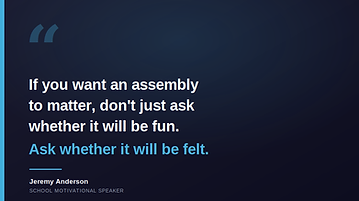
If you want an assembly to matter, do not just ask whether it will be fun. Ask whether it will be felt. Ask whether it will be remembered. Ask whether it will move the culture of your school in the right direction. That is what separates a good event from a great one. If you are ready to bring a message your students will remember, check Jeremy Anderson’s availability.


Comments